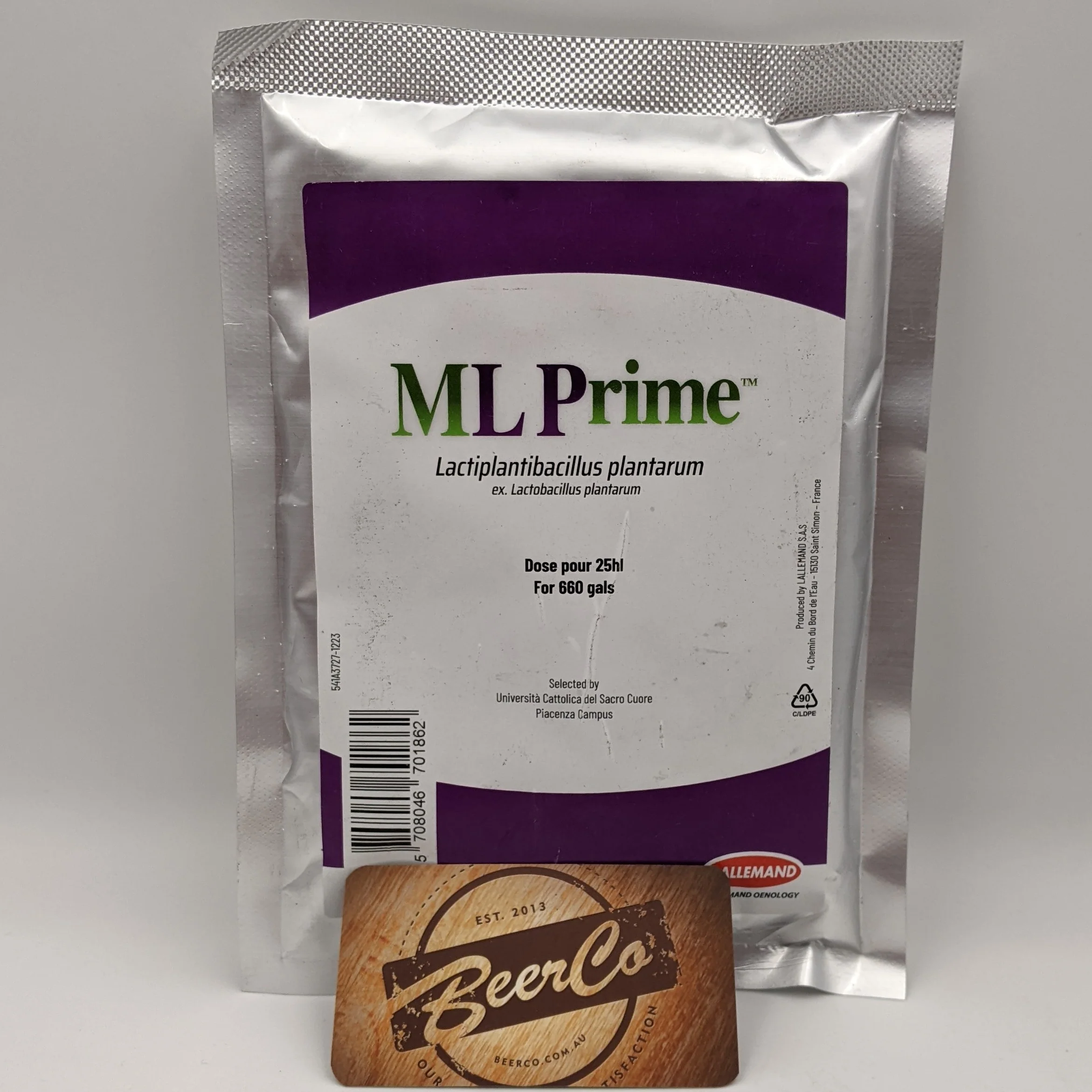
ML PRIME™ | Lactiplantibacillus plantarum | 250g | 25hL
ML Prime™ is a next-generation, active freeze-dried wine bacteria (Lactiplantibacillus plantarum) designed for rapid and reliable malolactic fermentation (MLF). Developed through a collaboration with the Università Cattolica del Sacro Cuore in Italy, this strain is optimized for winemakers seeking a fast, "no-risk" solution for malolactic fermentation in both red and white vinification.
Unlike traditional Oenococcus oeni strains, ML Prime™ possesses a unique facultative heterofermentative metabolism, meaning it cannot produce volatile acidity (acetic acid) from glucose or fructose. This allows for safe inoculation even while residual sugars are present, providing a "clean" fermentation that preserves fruit freshness and colour intensity.
Why Choose ML Prime™?
-
Ultra-Fast Kinetics: Complete MLF in as little as 3–15 days, often finishing alongside alcoholic fermentation.
-
Zero VA Risk: Peace of mind when inoculating musts with high residual sugar.
-
Sensory Integrity: Preserves fruit freshness and enhances colour intensity without producing buttery diacetyl or biogenic amines.
-
Early Stabilization: Finish MLF sooner to rack, sulphur, and protect your wine earlier, saving time and energy.
Application & Dosage Information
ML Prime™ is intended exclusively for co-inoculation (24 hours after yeast) or specific deacidification protocols. It does not have the capacity to multiply in finished wine under standard conditions, making dosage accuracy critical.
Standard Usage (Red & White Wine)
-
Method: Direct inoculation (no rehydration required).
-
Timing: Add to the fermenting must 24 hours after yeast inoculation
-
Recommended Dosage: 250 g per 25 hL (or 1 kg per 100 hL).
Temperature Range: Red Wine - 20°C to 26°C (68°F to 79°F) White Wine - 17°C to 22°C (63°F to 72°F)
Restarting Stuck MLF
For wines where MLF has stalled, a double dose (2x the standard rate) is recommended. Prior to inoculation, it is advised to detoxify the wine using yeast cell walls (such as Reskue™) to remove inhibitors like fatty acids or pesticide residues.
Can it be used for other beverages?
Cider: L. plantarum is frequently used in cider making to achieve malolactic fermentation (deacidifying harsh malic acid into softer lactic acid). Because cider often has higher malic acid levels and lower pH than wine, ML Prime™ can be highly effective, provided the pH remains above 3.05.
Beer (Sour Styles): In the brewing world, L. plantarum is the industry standard for "kettle souring" or co-fermentation to produce Gose or Berliner Weisse styles. However, brewers typically use a different Lallemand product called WildBrew™ Sour Pitch, which is a L. plantarum strain optimized for wort (high sugar, low hop tolerance). Tt is technically capable of souring, but you should note that it is extremely sensitive to hops (even 5–8 IBUs can inhibit it).
ML PRIME™ Lactiplantibacillus plantarum Technical Data Sheet
Packaging and Storage:
Product in powder form obtained by lyophilisation.
• Available for 25 hL (660 US gal.).
• Once opened, wine bacteria sachet must be used immediately.
• This product can be stored for 18 months at 4 °C/40 °F or 36 months at -18 °C/O °F in original sealed packaging.
• Sealed packets can be delivered and stored for 3 weeks at ambient temperature (< 25 °C/77 °F) without significant loss of viability. Alcohol-tolerant malolactic strains for the maturation of wines with average or high pH.
Original: $127.18
-65%$127.18
$44.51Product Information
Product Information
Shipping & Returns
Shipping & Returns
Description
ML Prime™ is a next-generation, active freeze-dried wine bacteria (Lactiplantibacillus plantarum) designed for rapid and reliable malolactic fermentation (MLF). Developed through a collaboration with the Università Cattolica del Sacro Cuore in Italy, this strain is optimized for winemakers seeking a fast, "no-risk" solution for malolactic fermentation in both red and white vinification.
Unlike traditional Oenococcus oeni strains, ML Prime™ possesses a unique facultative heterofermentative metabolism, meaning it cannot produce volatile acidity (acetic acid) from glucose or fructose. This allows for safe inoculation even while residual sugars are present, providing a "clean" fermentation that preserves fruit freshness and colour intensity.
Why Choose ML Prime™?
-
Ultra-Fast Kinetics: Complete MLF in as little as 3–15 days, often finishing alongside alcoholic fermentation.
-
Zero VA Risk: Peace of mind when inoculating musts with high residual sugar.
-
Sensory Integrity: Preserves fruit freshness and enhances colour intensity without producing buttery diacetyl or biogenic amines.
-
Early Stabilization: Finish MLF sooner to rack, sulphur, and protect your wine earlier, saving time and energy.
Application & Dosage Information
ML Prime™ is intended exclusively for co-inoculation (24 hours after yeast) or specific deacidification protocols. It does not have the capacity to multiply in finished wine under standard conditions, making dosage accuracy critical.
Standard Usage (Red & White Wine)
-
Method: Direct inoculation (no rehydration required).
-
Timing: Add to the fermenting must 24 hours after yeast inoculation
-
Recommended Dosage: 250 g per 25 hL (or 1 kg per 100 hL).
Temperature Range: Red Wine - 20°C to 26°C (68°F to 79°F) White Wine - 17°C to 22°C (63°F to 72°F)
Restarting Stuck MLF
For wines where MLF has stalled, a double dose (2x the standard rate) is recommended. Prior to inoculation, it is advised to detoxify the wine using yeast cell walls (such as Reskue™) to remove inhibitors like fatty acids or pesticide residues.
Can it be used for other beverages?
Cider: L. plantarum is frequently used in cider making to achieve malolactic fermentation (deacidifying harsh malic acid into softer lactic acid). Because cider often has higher malic acid levels and lower pH than wine, ML Prime™ can be highly effective, provided the pH remains above 3.05.
Beer (Sour Styles): In the brewing world, L. plantarum is the industry standard for "kettle souring" or co-fermentation to produce Gose or Berliner Weisse styles. However, brewers typically use a different Lallemand product called WildBrew™ Sour Pitch, which is a L. plantarum strain optimized for wort (high sugar, low hop tolerance). Tt is technically capable of souring, but you should note that it is extremely sensitive to hops (even 5–8 IBUs can inhibit it).
ML PRIME™ Lactiplantibacillus plantarum Technical Data Sheet
Packaging and Storage:
Product in powder form obtained by lyophilisation.
• Available for 25 hL (660 US gal.).
• Once opened, wine bacteria sachet must be used immediately.
• This product can be stored for 18 months at 4 °C/40 °F or 36 months at -18 °C/O °F in original sealed packaging.
• Sealed packets can be delivered and stored for 3 weeks at ambient temperature (< 25 °C/77 °F) without significant loss of viability. Alcohol-tolerant malolactic strains for the maturation of wines with average or high pH.